
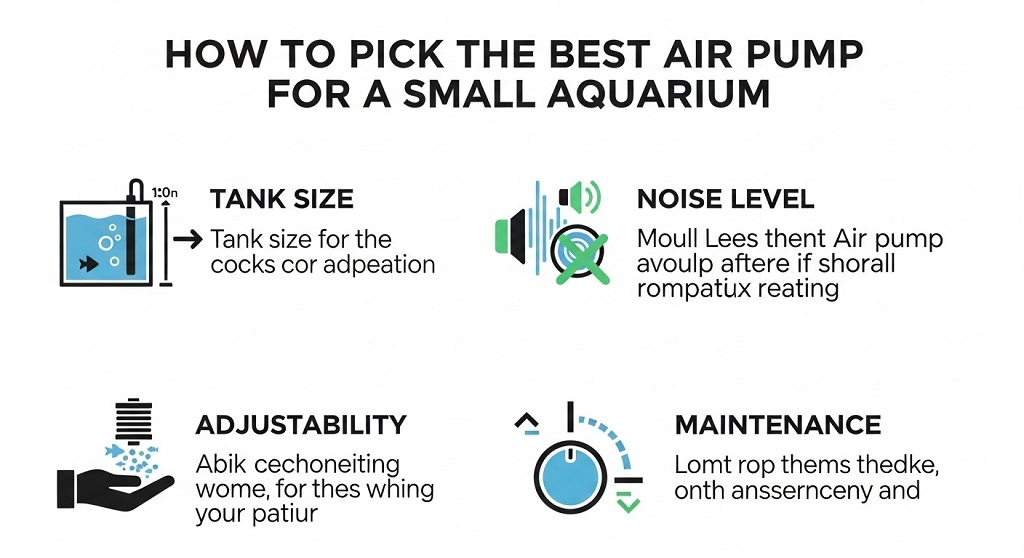
The best air pump for a small aquarium is a quiet, low-wattage nano tank air pump that matches your tank size (e.g., a 5 gallon tank pump), delivers steady airflow, and operates below 40 decibels.
Imagine this. You set up a beautiful 5-gallon nano tank. Clear water. Healthy plants. A few active fish. Then you plug in your air pump—and it hums louder than your refrigerator. That low vibration never stops. It ruins the calm you wanted.
This is a common problem. Many hobbyists buy oversized or cheap pumps without checking airflow output, noise levels, or compatibility. The result? Stressed fish, unstable oxygen levels, and constant noise.
The solution is simple. Choose a properly rated nano tank air pump designed for small aquariums. Match the airflow (liters per minute), pressure rating, and noise level to your tank volume. For a 5 gallon tank pump, look for 0.5–1.0 L/min output and under 3 watts of power consumption.
In this guide, you’ll learn exactly how to pick the best silent air pump, avoid common mistakes, and ensure stable aeration for your nano aquarium. No fluff. Just practical advice backed by real-world data and case examples.
Why Does a Small Aquarium Even Need an Air Pump?
Short answer: A small aquarium needs an air pump to increase oxygen exchange, improve water circulation, and support beneficial bacteria.
Problem: Small tanks hold less water. Less water means faster oxygen depletion and quicker waste buildup.
Agitation: In a 5-gallon tank, oxygen can drop quickly if water movement is low. Fish may gasp near the surface. Beneficial nitrifying bacteria struggle. Waste accumulates faster.
Solution: A properly sized nano tank air pump increases surface agitation. This improves gas exchange. It stabilizes dissolved oxygen (DO) levels and supports biological filtration.
According to aquaculture studies, dissolved oxygen below 5 mg/L can stress most freshwater fish species. In small, enclosed systems, oxygen levels can fluctuate more rapidly than in larger aquariums.
An air pump helps by:
- Driving sponge filters
- Powering air stones
- Enhancing water circulation
- Preventing dead spots
- Improving nitrification efficiency
Even planted tanks benefit during nighttime when plants consume oxygen instead of producing it.
How Do You Choose the Right Nano Tank Air Pump Size?
Short answer: Choose a pump rated slightly above your tank size but not oversized. For a 5 gallon tank pump, 0.5–1.0 L/min airflow is ideal.
Problem: Many hobbyists assume stronger is better.
Agitation: Oversized pumps create excessive bubbles. This increases evaporation and stresses fish. Undersized pumps fail to oxygenate properly.
Solution: Match airflow to tank volume.
| Tank Size | Recommended Airflow | Ideal Wattage |
|---|---|---|
| 3–5 gallons | 0.5–1.0 L/min | 1.5–3W |
| 5–10 gallons | 1.0–2.0 L/min | 2–4W |
Look for manufacturer specifications. Check both airflow (L/min) and maximum pressure (kPa). Small aquariums typically require low pressure unless running deep sponge filters.
A nano tank air pump designed specifically for compact aquariums ensures balanced aeration without turbulence.
What Makes a Silent Air Pump Truly Quiet?
Short answer: A silent air pump operates below 40 dB and uses vibration-dampening rubber mounts or piezoelectric technology.
Problem: Noise is the #1 complaint in small tank setups.
Agitation: In bedrooms or offices, constant humming can become distracting. Cheap pumps often vibrate against surfaces, amplifying noise.
Solution: Look for these features:
- Rubber feet or suspension design
- Magnetic or piezoelectric motor system
- Decibel rating under 40 dB
- Compact housing with sound insulation
Case example: A hobbyist community test measured three pumps in a 5-gallon setup. Pumps above 45 dB were perceived as intrusive. Pumps under 38 dB were considered nearly silent in normal room conditions.
If the manufacturer does not list decibel levels, check verified user reviews.
Should You Choose a Single or Dual Outlet Pump?
Short answer: For a 5 gallon tank pump, a single outlet is usually enough.
Problem: Dual outlet pumps are often marketed as better.
Agitation: In small aquariums, dual outlets can produce excessive airflow unless regulated.
Solution: Use single outlet for nano tanks. Choose dual outlet only if:
- You run two sponge filters
- You operate multiple nano tanks
- You need adjustable airflow control
Air control valves can help regulate excess pressure if using a stronger pump.
How Important Is Energy Efficiency in a Nano Tank Air Pump?
Short answer: Very important. Air pumps run 24/7, so low wattage reduces long-term electricity costs.
Problem: High wattage pumps increase utility bills.
Agitation: Even a 5W pump running continuously adds up annually.
Solution: Choose a 1.5–3W pump for small tanks.
Example calculation:
3W pump × 24 hours × 365 days = 26.28 kWh per year.
At $0.12 per kWh, that’s about $3.15 annually.
Energy-efficient nano tank air pumps also produce less heat, preventing unwanted temperature increases in small water volumes.
Do You Need Adjustable Airflow for a 5 Gallon Tank Pump?
Short answer: Yes, adjustable airflow provides flexibility and protects fish from stress.
Problem: Fixed airflow can be too strong.
Agitation: Betta fish and shrimp prefer gentle water movement.
Solution: Choose pumps with:
- Built-in flow dial
- Inline air valve compatibility
- Bleed valve option
This allows fine-tuning based on livestock needs.
What Accessories Improve Air Pump Performance?
Short answer: Use air stones, check valves, airline tubing, and sponge filters.
Problem: Many users skip essential accessories.
Agitation: Without check valves, water can backflow during power outages. This can damage the pump.
Solution: Essential accessories include:
- Air stone: Produces fine bubbles for better oxygen diffusion.
- Check valve: Prevents back-siphoning.
- Sponge filter: Adds mechanical and biological filtration.
- Air control valve: Regulates airflow.
Fine bubbles increase surface area contact, improving gas exchange efficiency.
What Are Common Mistakes When Buying a Nano Tank Air Pump?
Short answer: Oversizing, ignoring noise ratings, and skipping safety features.
Common mistakes:
- Buying the cheapest model available
- Ignoring decibel ratings
- Not checking airflow specs
- Skipping check valves
- Placing pump below water level without protection
Each of these leads to performance or safety issues.
How Do You Install an Air Pump Properly?
Short answer: Place above water level or use a check valve, connect airline tubing securely, and test airflow before adding fish.
Installation steps:
- Position pump on stable surface.
- Connect airline tubing.
- Insert check valve.
- Attach air stone or sponge filter.
- Plug in and adjust airflow.
Always test for leaks and vibration noise before final placement.
Conclusion: How Do You Pick the Best Air Pump for a Small Aquarium?
The best air pump for a small aquarium is not the most powerful. It’s the most appropriate for your tank size.
Focus on:
- Correct airflow (0.5–1.0 L/min for 5 gallons)
- Low noise (under 40 dB)
- Energy efficiency (1.5–3W)
- Adjustable control
- Safety accessories
A well-chosen nano tank air pump protects fish health, improves filtration, and keeps your space quiet.
Ready to upgrade your setup? Evaluate your current pump today. Check airflow specs. Measure noise levels. Make the change before problems appear.
Your fish depend on stable oxygen. Choose wisely.
Frequently Asked Questions (FAQs)
What size air pump do I need for a 5 gallon tank?
A 5 gallon tank pump should provide 0.5–1.0 liters per minute airflow with 1.5–3 watts of power.
Can an air pump be too strong for a nano tank?
Yes. Excessive airflow stresses fish and increases evaporation. Always match output to tank volume.
Are silent air pumps really silent?
No pump is completely silent. However, models under 40 dB are barely noticeable in most rooms.
Do small planted tanks need air pumps?
Yes, especially at night when plants consume oxygen. Air pumps stabilize oxygen levels.
How long should an aquarium air pump run?
Air pumps should run continuously (24/7) for consistent oxygenation and filtration support.
What happens if I don’t use a check valve?
Water can siphon backward during power outages and damage the pump.
Related Topics: What are the duties of a care home worker?
What Next: Space Saving Garage Doors for Narrow Driveways