California parents face a unique challenge when shopping for baby skincare. Between the state’s strict environmental regulations, the hot and dry climate, and an overwhelming number of products on store shelves, finding a truly safe lotion for your little one’s delicate skin can feel like a research project. You are not just looking for any moisturizer; you need one that is free from harmful chemicals, effective for your baby’s specific skin type, and compliant with the strictest safety standards. This guide cuts through the marketing noise to explain what “safe” really means, which ingredients to avoid, and how to choose the safest baby lotion in California for your family’s needs. We’ll cover the regulatory landscape, common hidden hazards, and provide a practical framework for making a confident, informed decision you can feel good about.
Key Takeaways
- California’s Prop 65 and the California Safer Consumer Products Program create a unique regulatory environment that influences product formulation, but “sold in California” does not automatically mean a product is safe or clean.
- The most practical approach is to become a label detective, prioritizing fragrance-free formulas and avoiding parabens, phthalates, and undisclosed “parfum” ingredients.
- Your baby’s specific skin condition (normal, dry, or eczema-prone) should dictate the type of formula you choose—not just the brand name.
- You don’t need a long ingredient list. Short, recognizable, plant-based ingredient lists often indicate a gentler, safer product.
Understanding California’s Safety Standards
When you search for the safest baby lotion in California, it’s helpful to understand exactly what the state regulates. California is a leader in chemical safety, often implementing rules that go beyond federal requirements. The most significant is the California Safe Drinking Water and Toxic Enforcement Act of 1986, commonly known as Proposition 65. This law requires businesses to provide warnings about significant exposures to chemicals that cause cancer, birth defects, or other reproductive harm. This means you may see Prop 65 warnings on some products, but it’s important to know these warnings are not necessarily a “ban” – they are a notification. For personal care products specifically, the California Safer Consumer Products (SCP) program works to identify and reduce chemicals of concern in consumer goods, pushing manufacturers to reformulate.
Because of these stringent laws, many national and international brands reformulate their products to meet California’s strict standards. However, the crucial takeaway is this: the regulations focus on eliminating specific, known toxins, but they don’t vet products for all potential irritants or allergens. Therefore, relying on the state to ensure a product is safe for your baby is not the same as actively choosing a clean, gentle formula yourself. You still need to review the ingredient list with a discerning eye to ensure you are getting the safest baby lotion in california for your specific child.
The Real Difference Between “Natural” and “Safe”
In the world of baby skincare, the terms “natural,” “organic,” and “safe” are often used interchangeably, but they mean very different things. A “natural” label does not automatically mean the product is safe for all babies. For instance, essential oils are natural, but they can be highly irritating to a newborn’s sensitive skin and can even cause allergic reactions. “Organic” refers to how the ingredients are grown, which is excellent for reducing pesticide exposure, but it doesn’t guarantee the final formulation is free from irritating compounds. Safety in this context is about selecting non-toxic ingredients that are also non-irritating and non-sensitizing for your baby’s specific skin. The safest choices often contain the simplest, most inert ingredients—like shea butter, jojoba oil, or colloidal oatmeal—that are more about soothing and moisturizing than they are about adding fragrance or botanical extracts.
The Problem with “Fragrance” and “Parfum”
This is arguably the single most critical label-reading skill you need as a parent. On an ingredient list, the word “fragrance” or “parfum” is a catch-all term. According to US regulations, a manufacturer can use this one word to hide dozens of different chemical compounds—some of which have been linked to allergens, hormone disruption, and skin irritation. A product might be free from parabens and phthalates, but if it includes undisclosed “fragrance,” it could still contain these irritants. The safest approach is to look for products that are explicitly labeled “fragrance-free.” This is different from “unscented,” which can sometimes contain masking fragrances that are added to hide the smell of other ingredients.
Key Ingredients to Avoid Completely
While regulations like Prop 65 help, a robust safety checklist goes beyond the legal minimum. Here are the major culprits to avoid when assessing safety:
- Parabens (Methylparaben, Propylparaben): Used as preservatives, these have been linked to endocrine disruption.
- Phthalates (DBP, DEP): Often hidden in fragrances, they are used to make scents last longer and are linked to reproductive issues.
- Formaldehyde Releasers (DMDM hydantoin, Quaternium-15): These are preservatives that slowly release formaldehyde, a known carcinogen.
- Synthetic Dyes (FD&C, CI numbers): Added purely for aesthetics, they serve no benefit and can cause skin irritation.
- Essential Oils: While natural, they are potent and can irritate sensitive baby skin, especially in high concentrations.
A Step-by-Step Guide to Choosing the Right Lotion
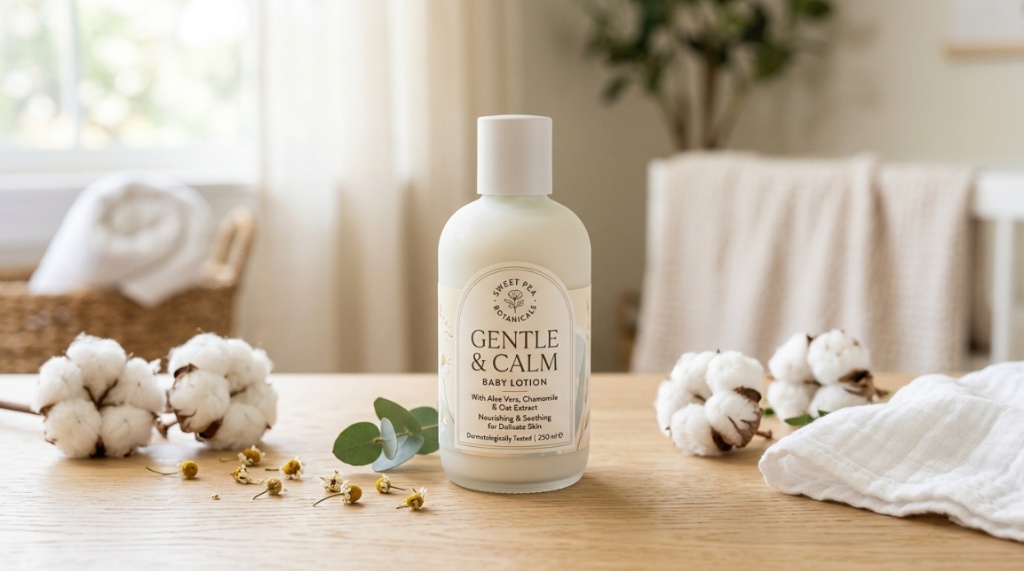
Once you know what to avoid, the selection process becomes much more manageable. Following a structured approach will help you filter through dozens of options to find o one that fits your baby’s needs. Here is a simple step-by-step framework you can use both online and in the store.
Step 1: Determine Your Baby’s Skin Need
Before you read a single label, look at your baby’s skin. Do they have normal, healthy skin that just needs daily moisture? Or do they have dry patches, flakiness, or red, inflamed areas that suggest eczema? Your baby’s need determines the base formula. For normal skin, a light daily moisturizer is sufficient. For severely dry or eczema-prone skin, you will need a richer ointment or cream that contains ingredients like colloidal oatmeal or ceramides to repair the skin barrier.
Step 2: Scan the Ingredient List
Now, turn the bottle over and put your detective hat on. Look at the very top of the ingredient list—ingredients are listed in order of concentration. The first few ingredients are the most important. If you see water followed by a recognizable oil like sunflower or jojoba, that is promising. If you see a lengthy list of unrecognizable, chemical-sounding names early on, it’s best to put it back. Look for the active benefits, like shea butter or glycerin, and ensure there are no hidden fragrances before moving to the next step.
Step 3: Check the Seal and Packaging
Safety also involves how the product is dispensed. Avoid jars where you have to dip your fingers in. Every time you touch the product, you introduce bacteria, which requires more preservatives to keep the formula stable. Pumps or squeeze tubes are superior because they keep the formula sealed and protected from contamination. This is an often-overlooked factor that influences both the safety and longevity of your lotion.
Step 4: Consider the Climate
California’s climate varies dramatically—from the humid coast to the arid desert and the cool mountains. If you live in a dry, hot climate like the Central Valley or inland Southern California, you might need a denser, more emollient cream to prevent water loss. In more humid coastal areas, a lighter lotion or gel might be sufficient. Don’t buy a thick ointment if you live in a humid area, as it might feel heavy and clog little pores.
Comparing Lotion Types: Creams vs. Ointments vs. Lotions
Many parents use the words “lotion” and “cream” interchangeably, but they are very different in their composition and effectiveness. Understanding the difference is key to treating your baby’s skin effectively. This table breaks down the distinctions to help you make a faster decision.
| Type | Water Content | Best For | Texture & Feel |
|---|---|---|---|
| Lotion | High (Lightest) | Daily hydration for normal skin | Thin, fast-absorbing, watery |
| Cream | Moderate (Balanced) | Moderate to dry skin, winter months | Thicker, richer, sits on skin briefly |
| Ointment | Low (Heaviest) | Severe dryness, eczema flare-ups, barrier protection | Thick, greasy, petroleum or wax-based |
Most “daily” lotions have a high water content, making them easy to spread but not very effective for severe dryness. Ointments, on the other hand, are occlusive—they create a physical barrier that seals moisture in. For a baby with active eczema, an ointment is often the safest and most effective choice because it reduces water loss and prevents irritants from touching the skin. However, it may not be enjoyable to apply because it feels heavy, so many parents prefer a cream for daily use and save the ointment for nighttime or flare-ups.
Patch Testing: The Final Safety Check
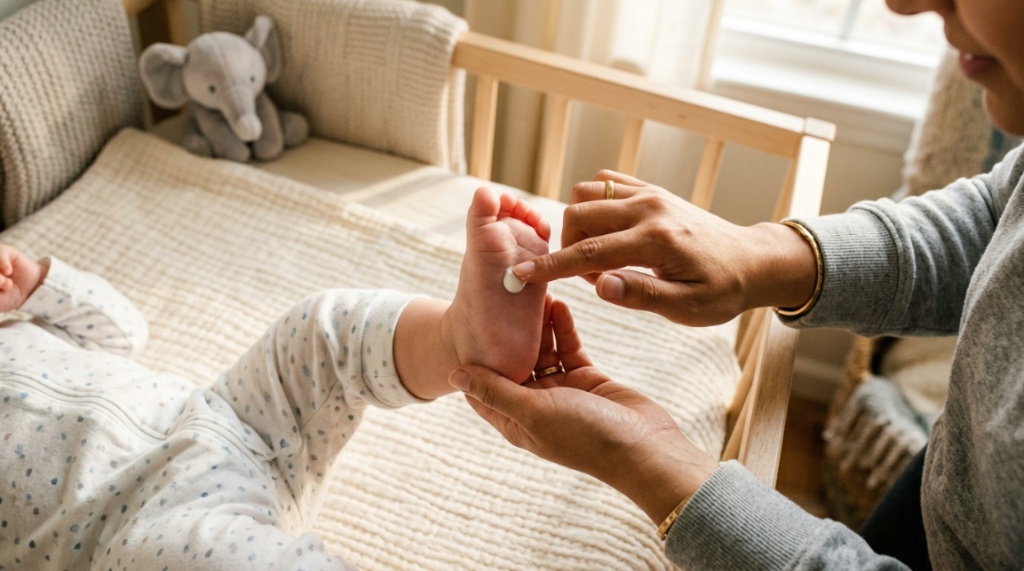
Even after all your research and label reading, your baby’s unique biology is the ultimate deciding factor. Introducing a new product can occasionally cause a reaction, even if it is a clean, fragrance-free formula. A patch test is the best way to minimize this risk before slathering a new lotion all over your baby’s body. Apply a small, dime-sized amount of the product to a small area of skin, such as the inner forearm or behind the ear. Wait 24 hours and observe the area. If you see any redness, bumps, or irritation, stop using the product immediately. If no reaction occurs, it is generally safe to use on larger areas of the body. This simple step is a powerful tool, especially for parents of babies with sensitive or allergy-prone skin,
Curious about typical sensory habits in early childhood? Read more about infant sensory development and check out Is it Normal for Babies to Like Spinning Wheels? to understand these fascinating behaviors.
Frequently Asked Questions
Is “organic” lotion always the safest choice?
Not necessarily. While organic lotions avoid synthetic pesticides, they may still contain natural ingredients that are irritating, such as essential oils or plant extracts. “Organic” refers to agricultural practices, not the safety of the final formulation. Always check the full ingredient list for irritants, even if the product is certified organic.
Can I use adult moisturizer on my baby?
It’s best to avoid adult moisturizers. Adult formulas often contain active ingredients like retinol, alpha-hydroxy acids, or heavy fragrances that are too harsh for a baby’s developing skin. They also have a different pH balance. Stick to products specifically formulated for infant skin to avoid unnecessary irritation.
What is the difference between fragrance-free and unscented?
Fragrance-free means no fragrance ingredients are added to the product. Unscented means the product has no discernible smell, but the manufacturer may have added a “masking fragrance” to neutralize the odor of other ingredients. For the safest option, always choose products explicitly labeled “fragrance-free.”
How often should I apply lotion to my baby?
For normal skin, once a day after a bath is sufficient. For dry or eczema-prone skin, you may need to moisturize twice or three times daily. The best time is within three minutes after a bath to lock in moisture while the skin is still slightly damp. Always follow the guidance of your pediatrician for specific skin conditions.
Are preservatives bad for my baby’s skin?
No, preservatives are necessary to prevent harmful bacteria and mold from growing in the product and causing an infection. The key is to find preservatives that are safe and non-irritating. Look for alternatives like phenoxyethanol or ethylhexylglycerin if you are concerned about parabens, which are a different class of preservative.
Conclusion
Finding the safest baby lotion in California comes down to a combination of understanding local regulations, decoding ingredient labels, and knowing your baby’s specific skin physiology. The state’s robust safety laws provide a strong baseline, but they cannot replace the vigilance of an informed parent. By prioritizing fragrance-free formulas, avoiding known irritants like parabens and phthalates, and selecting the correct texture (lotion, cream, or ointment) for your child’s needs, you can effectively manage your baby’s skin health. Remember to perform a simple patch test with any new product. This process might seem meticulous now, but it will soon become a quick, intuitive habit as you learn which brands and ingredients your baby’s skin loves. You are not just buying a moisturizer; you are building a healthy foundation for your child’s long-term skin barrier function.